
The pantry reset — stocking a kitchen that makes eating well the easy choice
The Healthy-ish Reset · Post 06 of 10

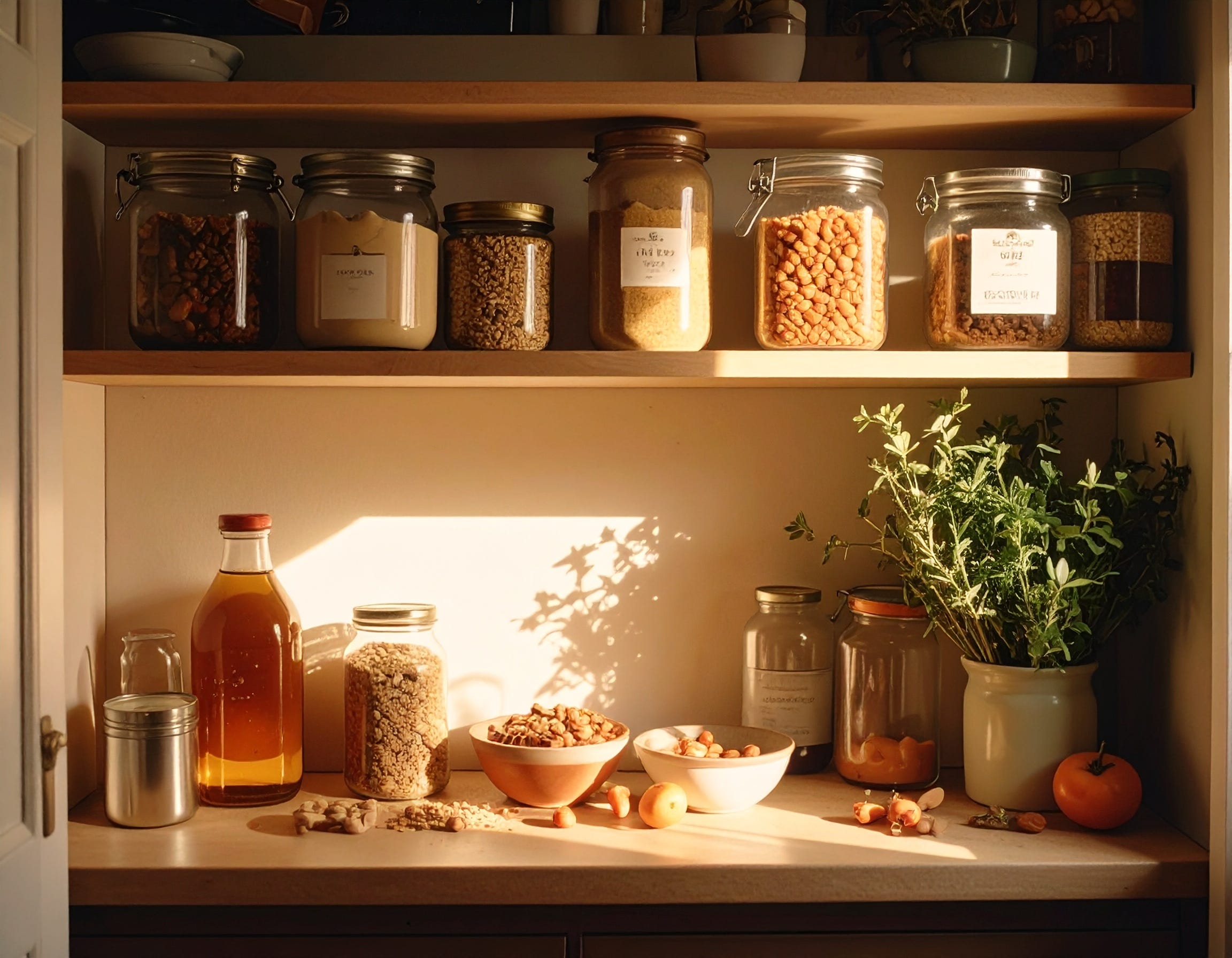
There is a well-documented principle in behavioral science that goes something like this: the easier a behavior is to perform, the more likely you are to perform it. The harder it is, the less likely. This is not a commentary on willpower. It is just how humans work.
Applied to eating, the implication is straightforward. If your kitchen is stocked with ultra-processed food and your refrigerator is empty of anything that requires cooking, you will eat ultra-processed food. Not because you lack discipline. Because it is the easiest thing available. Conversely, if your kitchen is stocked with the ingredients for the meals in your repertoire — the meals from Post 05 that you actually want to eat — those meals become the easy choice rather than the effortful one.
This is the pantry reset. Not a purge. Not a prescription. A deliberate adjustment to your environment so that the way you want to eat becomes the path of least resistance rather than the path of most effort.
A note before we begin: The Healthy-ish Reset is a philosophical approach to building a healthier, more peaceful relationship with food. It is not medical or nutritional advice, and it is not a substitute for guidance from a registered dietitian or your doctor. If you have specific health concerns, a medical condition, or a complicated history with food and eating, please speak with a qualified professional who can support you personally. What you will find here is a way of thinking — not a prescription.
Why environment matters more than intention
Most approaches to eating better focus on intention — deciding to eat well, committing to a plan, summoning the motivation to follow through. Intention matters. But it is also the least reliable lever available, because it requires active mental effort every time a food decision is made. And food decisions are made dozens of times a day, often when attention is elsewhere, energy is low, and the path of least resistance is the only path that feels viable.
Environment, by contrast, works passively. A kitchen stocked with ingredients for quick, nourishing meals does not require a decision every time you are hungry. It requires one decision — the shopping — and then delivers on that decision repeatedly throughout the week without additional effort. A bowl of fruit left on the counter gets eaten more than fruit stored out of sight in the refrigerator. A bag of chips visible on the shelf gets eaten more than one stored out of sight. These are not moral failures. They are predictable responses to environmental cues.
The research on this is consistent and has been for decades. People eat what is available, visible, and convenient — with remarkable reliability, regardless of their stated intentions. Setting up a kitchen that makes nourishing food available, visible, and convenient is one of the highest-leverage changes anyone can make to how they eat — and it requires effort only once, at the point of setup, rather than every time a food decision arises.
What a reset is not
Before getting into what belongs in a well-stocked kitchen, it is worth being clear about what this process is not.
It is not an elimination exercise. The pantry reset does not require throwing away everything that does not meet a nutritional standard. That approach — the dramatic clear-out, the fresh start — is the same all-or-nothing thinking that Post 01 identified as the root of the starting-over cycle. A kitchen that contains some ultra-processed food alongside whole food staples is a normal kitchen. The goal is proportion, not purity.
It is not a prescription. There is no universal list of things every kitchen must contain. What belongs in your pantry depends on the repertoire you identified in Post 05 — the meals you actually want to cook. A pantry stocked for someone who loves Japanese food looks different from one stocked for someone who loves Mexican food, which looks different again from one stocked for someone who loves a simple rotation of roasted vegetables and grains. The principle is the same. The contents are yours.
It is not a one-time event. A pantry reset is a starting point, not a permanent state. Ingredients get used. Preferences change. Seasons shift what is available and what sounds appealing. The reset is something you return to periodically — not as a dramatic intervention, but as a quiet maintenance habit, the way you might occasionally tidy a workspace that has drifted into disorder.
The three layers of a well-stocked kitchen
A useful way to think about stocking a kitchen is in three layers — each with a different role and a different restocking frequency.
The foundation layer. These are the staples that form the backbone of the meals in your repertoire — the ingredients that appear across multiple dishes and that you want to have on hand at all times. For most people this means: a selection of whole grains (rice, oats, whole grain pasta, farro or similar), a selection of legumes (canned beans, canned lentils, dried lentils), a selection of canned goods (canned tomatoes, canned fish, coconut milk if you use it), cooking oils, vinegars, salt, and the spices and condiments your cooking actually relies on. A well-stocked foundation layer does not require expensive ingredients — dried lentils, canned beans, whole grain pasta, and canned tomatoes are among the most affordable items in any grocery store and among the most nutritionally useful. These are bought in bulk when possible, restocked before they run out, and form the core of what makes a meal possible on a night when you have not planned anything.
The fresh layer. These are the perishable ingredients that complete the meals — the vegetables, the protein, the fresh herbs, the eggs, the dairy if you use it. These are bought weekly based on what you plan to cook, with some buffer for the nights when plans change. The key principle here is buying what you will actually use rather than what you aspire to use. A refrigerator full of vegetables that wilt before being cooked is not a well-stocked kitchen — it is a source of guilt and waste. Better to buy less and use it than to buy aspirationally and throw it away.
The quick-reach layer. These are the things you reach for when you need something fast — the food that competes most directly with the ultra-processed defaults from your audit. Nuts and seeds. Good quality crackers. Nut butter. Hard-boiled eggs prepared in advance. Fruit that does not require preparation. Hummus. Cheese. These are the items that make the difference between reaching for a bag of chips and reaching for something that actually serves you — not because they are dramatically healthier, but because they are equally convenient and more nourishing.
The visibility principle
Stocking the right things is necessary but not sufficient. Where you put them matters almost as much as what they are.
Food that is visible gets eaten. Food that is hidden gets forgotten. This is not a character flaw — it is a well-documented feature of how human attention and decision-making work under conditions of low energy and competing demands, which is most of the time.
Apply this practically. Keep fruit that stores well at room temperature — apples, bananas, citrus, stone fruit — on the counter rather than in the refrigerator. Keep the nuts in a bowl or a clear jar on the shelf, not in a bag in a cupboard. Keep the leftovers from last night’s dinner at eye level in the refrigerator, not at the back of a lower shelf. Keep the vegetables washed and cut and ready in clear containers rather than in the crisper drawer where they will be ignored until they are past their best.
Conversely, make the ultra-processed food slightly less visible. Not hidden, not forbidden — just not the first thing you see when you open the cupboard or the refrigerator. A small amount of friction goes a long way. The research on this consistently shows that even minor increases in the effort required to access a food significantly reduce how much of it is eaten.
The shopping habit that makes everything else possible
A stocked kitchen requires a shopping habit. Without one, the foundation and fresh layers deplete and do not get replenished, the quick-reach options run out at the moments they are most needed, and the kitchen reverts to whatever is easiest to order or buy on the way home.
The simplest version of this habit is a weekly shop based on a loose plan — not a rigid meal plan for every dinner, but a sense of what you intend to cook that week and what ingredients you need for it, combined with an automatic restock of whatever foundation layer staples are running low. This does not need to be elaborate. Fifteen minutes once a week, a shopping list built around your repertoire, and a consistent day to do it is enough to keep most kitchens functional.
The other half of the shopping habit is knowing what to do when the plan falls apart — when the week did not go the way you expected and the fresh ingredients were not used. A well-stocked foundation layer means that even an empty refrigerator does not mean there is nothing to eat. Pasta with canned tomatoes and olive oil. Lentil soup from dried lentils and whatever vegetables are left. Rice and canned beans with whatever spices are on the shelf. These are not exciting meals. They are reliable ones, and reliability on a difficult Wednesday is worth more than excitement on a Sunday when everything is going well.
Where Part Two ends
The three posts of Part Two have moved from audit to repertoire to environment. Together they form a practical arc: see clearly what you are working with, decide what you want to eat instead, and set up the conditions that make eating that way sustainable rather than effortful.
That is the infrastructure of better eating. Part Three is about what happens next — how to manage the parts of eating that infrastructure cannot solve. Cravings. Hard weeks. The role of pleasure in all of this. And what it looks like to keep going for the long term, not as a program, but as a life.
Post 07 arrives next week: Managing cravings without fighting them.
The Healthy-ish Reset is a ten-part series — free for all Joyvela readers. All ten posts are available in the archive at joyvela.io.