
The surprisingly powerful relationship between cooking and mental health
It is not just about the food. It never was.

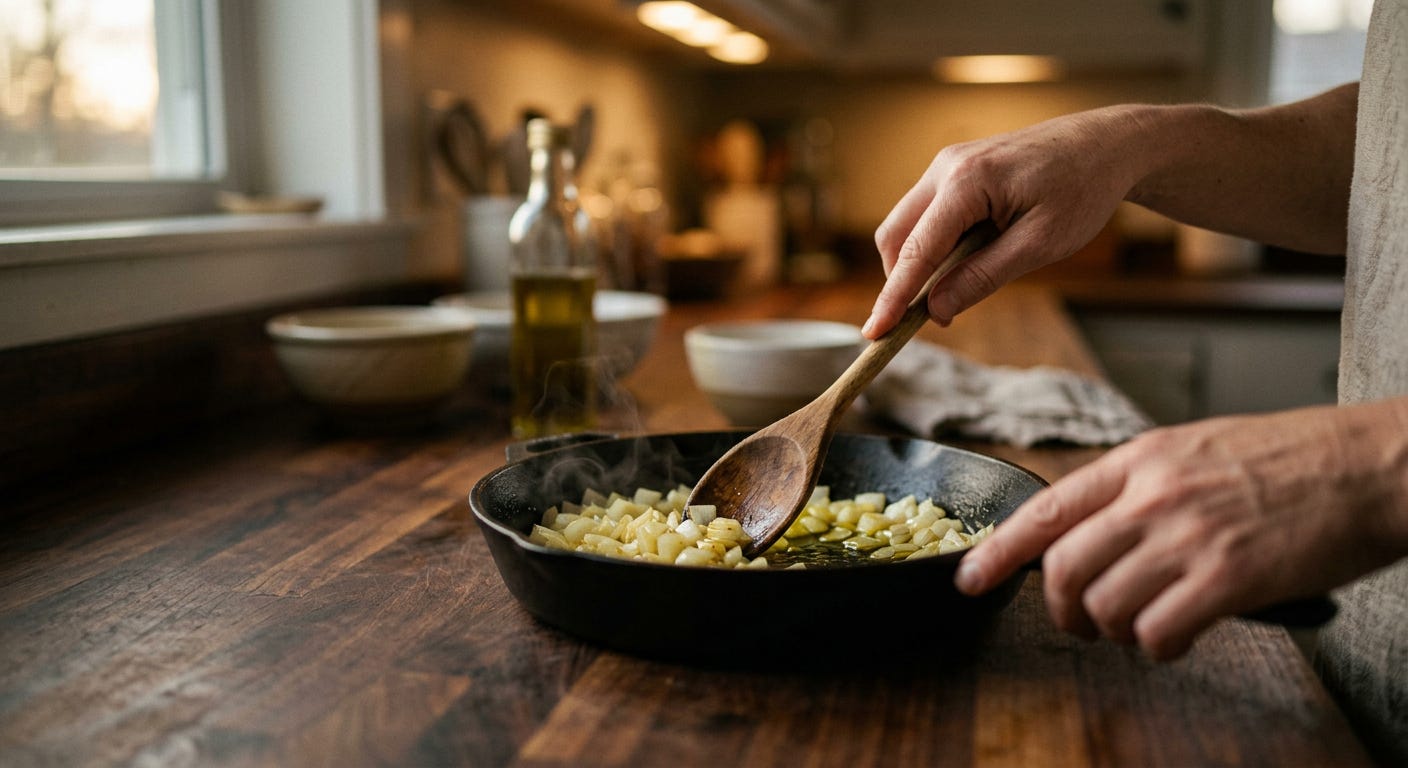
There is something that happens when you cook that does not happen when you order in.
It is not nutritional. It is not about the quality of the ingredients or the health profile of the meal. It is something more immediate and more psychological — a shift in mental state that occurs in the process of cooking itself, independent of what you are making or how well it turns out.
Most people who cook regularly have noticed it without necessarily naming it. The day that felt impossible becomes manageable somewhere between chopping the onion and watching it soften in the pan. The anxiety that followed you home from work gets quieter while you are focused on not burning the garlic. The grinding, circular thinking that characterized the first hour of the evening is interrupted by the requirement to do something specific with your hands and your attention. You arrive at dinner feeling different than you arrived at home — not because the food has done anything yet, but because the cooking has.
This is not a wellness claim or a lifestyle aspiration. It is a well-documented psychological phenomenon with a reasonably well-understood mechanism, and understanding it changes how you think about weeknight cooking — not as a chore to be optimized or a health strategy to be maintained, but as one of the most accessible and underrated mental health tools available to people in their daily lives.
What cooking does to the brain
Cooking is a behaviorally complex activity that requires sustained, moderate attention — enough to occupy the mind without overwhelming it. This is the sweet spot that psychologists describe as flow-adjacent experience: not the total absorption of deep flow states, which require more skill and more challenge than most weeknight cooking provides, but a gentler version of the same phenomenon — a state of engaged, present-focused attention that is incompatible with the ruminative, backward-looking thinking that characterizes anxiety and low mood.
Rumination — the tendency to replay difficult events, catastrophize future ones, and return repeatedly to the same distressing thoughts — is one of the primary cognitive mechanisms of anxiety and depression. It is also specifically interrupted by tasks that require moderate, focused attention. Cooking is particularly effective at this interruption because it engages multiple sensory channels simultaneously — smell, sound, sight, touch, and eventually taste — which gives the mind less room to wander than a task that uses only one.
The requirement to do things in sequence — to follow a process with a clear beginning, middle, and end — also provides a structure that naturally anxious minds find stabilizing. A person in the grip of anxiety is often dealing with a world that feels chaotic and uncontrollable. Cooking is controllable. You add the garlic when the onion is golden. You add the liquid when the spices are bloomed. You taste and adjust. The process has logic, and engaging with that logic produces a sense of agency and competence that the anxious mind is often specifically lacking.
The neuroscience of making something
Beyond the attentional benefits of cooking as a focused activity, there is a more specific neurological benefit to making something with your hands that eating alone does not provide.
Making something — any kind of making, but physical making in particular — activates the dopamine system in a way that consumption does not. The brain produces dopamine not just in anticipation of reward but in anticipation of a particular kind: one that results from effort and skill. The neurological signature of making a good meal is meaningfully different from that of opening one from a delivery bag — the former involves the anticipatory satisfaction of effort, the recognition of skill, and the connection between action and outcome that the brain’s reward system is specifically designed to celebrate.
This is why making things feels good in a way that is qualitatively different from having things. And it is why the modest dopamine hit of a successfully cooked weeknight meal — a sauce that came together, a chicken thigh with the skin exactly right, a dahl that turned out better than the last one — has an effect on mood that is disproportionate to the apparent scale of the achievement.
The scientific term for this is the IKEA effect — named after the furniture brand but applicable to any context where effort produces ownership, and ownership produces disproportionate positive valuation. We value what we make more than what we acquire, and we feel better for having made it. Cooking is one of the daily contexts where this effect is most readily available.
Cooking as sensory grounding
There is a specific subset of mental health benefit that cooking provides that is worth naming separately: sensory grounding.
Grounding is a clinical term for the practice of anchoring attention in the present moment through sensory experience — using what you can see, hear, smell, touch, and taste to interrupt the mind’s tendency to project into the future or replay the past. It is used therapeutically in the treatment of anxiety disorders, PTSD, and dissociative experiences, and it is one of the more reliably effective immediate interventions for acute anxiety.
Cooking is a natural grounding activity. The smell of onions in hot oil is unmistakably immediate. The sound of garlic sizzling is grounding. The weight of a pan in the hand, the resistance of a vegetable under a knife, the heat of a flame adjusted by a small turn of the wrist — these are all present-moment sensory experiences that require no special skill or mindfulness training to access. You do not have to be good at cooking for it to ground you. You just have to be in the kitchen, paying some degree of attention to what is happening in front of you.
This is not the same as formal mindfulness practice — it does not require intention or training or any particular relationship with the concept of being present. It is the simpler, more ordinary experience of doing something physical that keeps you here, in this kitchen, on this Tuesday, rather than somewhere in the anxiety-producing future or the regret-producing past.
The social dimension
Cooking for others is a different psychological experience from cooking for yourself, and worth distinguishing.
Cooking for others activates what psychologists call prosocial behavior — behavior directed toward the welfare of others — and the research is consistent that this is one of the more reliable predictors of wellbeing. The act of preparing food for someone else — choosing what they might enjoy, considering their preferences, putting effort into something for their benefit — produces a kind of purposeful connection that eating alone cannot replicate. It is one of the oldest and most fundamental expressions of care between people, and the psychological benefit flows in both directions: the person who receives a home-cooked meal experiences it as an act of care, and the person who made it experiences the satisfaction of having expressed care through action.
This does not require elaborate cooking or special occasions. A simple weeknight meal made for a housemate, a partner, a child, a friend who happens to be around — these ordinary acts of feeding people carry psychological weight that is entirely disproportionate to their culinary complexity. The simplest meal, made with attention and care, communicates something that no restaurant delivery can replicate: that you thought about this person, that you put effort into something for them, that their nourishment was worth your time.
When cooking does not help
There is an important caveat to everything above, and it is one that honest writing about cooking and mental health requires.
Cooking is not a treatment for serious mental illness. The benefits described here — attentional interruption of rumination, the dopamine hit of making something, sensory grounding, the prosocial satisfaction of feeding others — are real and meaningful for the ordinary spectrum of stress, anxiety, and low mood that most people navigate in ordinary life. They are not adequate interventions for clinical depression, for severe anxiety disorders, for trauma, or for the genuinely difficult periods of mental illness that require professional support.
There is also a version of this that makes mental health worse rather than better — the cooking that is driven by anxiety rather than interrupted by it. The rigid, rule-governed approach to food that is really a form of control, the obsessive attention to nutrition that is really a displacement of other anxieties, the cooking that produces guilt and shame rather than pleasure and satisfaction. This version of cooking is not a mental health tool. It is a mental health symptom, and it is worth naming as such.
The cooking that supports mental health is the kind that is done with reasonable pleasure and without perfectionism. The kind where scrambled eggs on a hard night counts as much as an elaborate meal on a good one. The kind where the process is the point as much as the result, and where a meal that did not turn out perfectly is still a meal that was worth making.
Why this matters for weeknight cooking
The case for weeknight cooking is usually made on nutritional or financial grounds — cooking at home is healthier and cheaper than eating out. Both of these things are true, and both of them matter.
But they miss the most immediate and most personal benefit of cooking regularly, which is what it does to the twenty to thirty minutes in which it happens. Those minutes are not just a means to an end — a meal to be consumed and a health box to be checked. They are a daily interruption to the mental noise of modern life, a small act of making in a world that increasingly involves only consuming, a sensory present-moment experience in an attention economy that profits from keeping you abstracted and distracted.
This is what Joyvela has always believed — not just that cooking produces better food, but that cooking produces better evenings. That the act of making dinner, done regularly and without excessive pressure, is one of the more quietly powerful things most people can do for their own mental wellbeing on an ordinary Tuesday.
The food is good. The cooking is better.