
What healthy-ish actually means — and why it’s better than healthy
The case for ditching the all-or-nothing approach to food — and what to do instead.

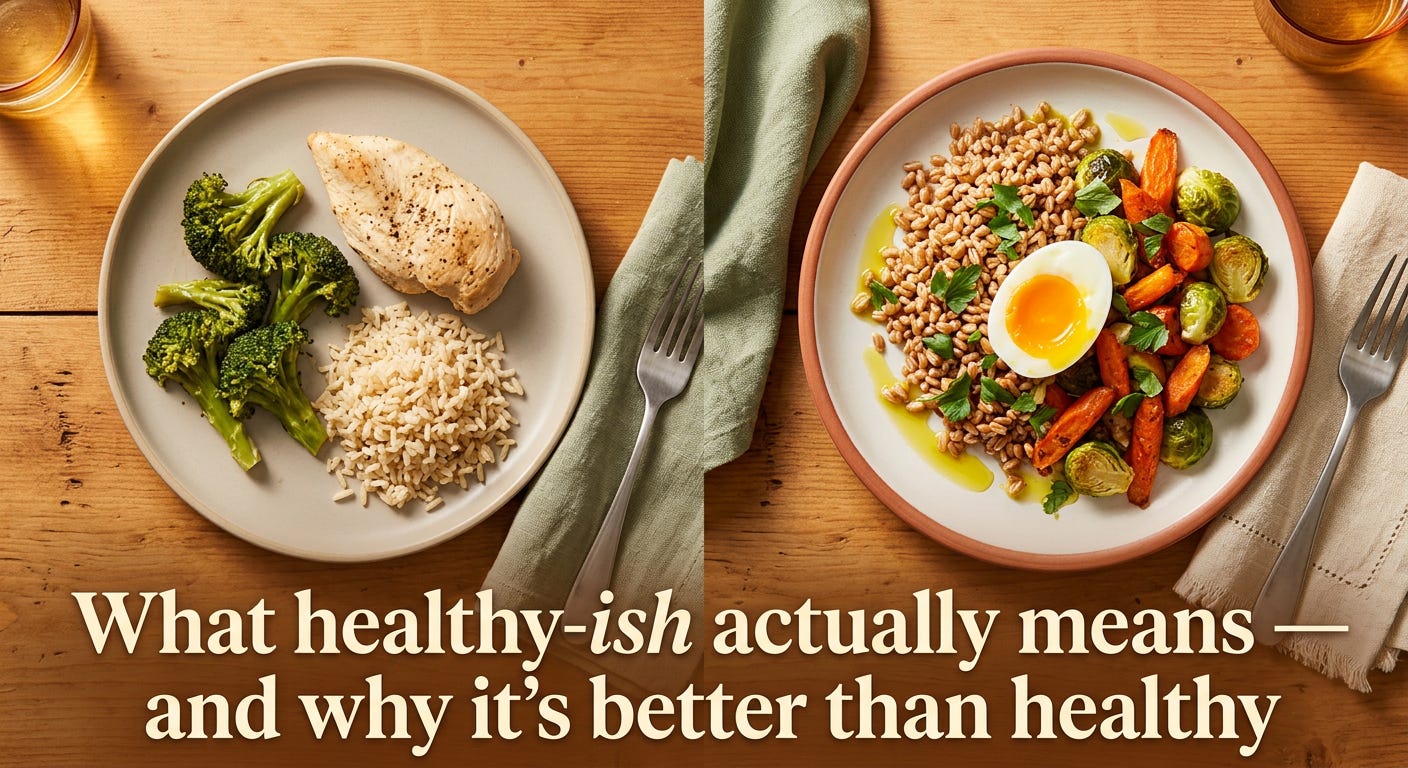
There is a word that has quietly become one of the most loaded in the English language. It shows up on menus, on packaging, in Instagram captions, in the names of entire restaurant chains. It gets applied to everything from a bowl of quinoa to a chocolate bar with a slightly reduced sugar content. It is used to sell, to shame, to inspire, and to confuse — often all at once.
The word is healthy.
And the more it gets used, the less useful it becomes.
Ask ten different people what healthy eating looks like and you will get ten different answers. One person will tell you it means cutting carbs. Another will tell you carbs are fine but sugar is the enemy. Someone else will say it’s all about protein. Another will tell you it’s about plants. One person tracks macros. Another tracks nothing but eats intuitively. Someone swears by intermittent fasting. Someone else thinks skipping meals is the worst thing you can do. All of them are certain they’re right. Many of them have data to back it up.
This is not a coincidence. It is the inevitable result of an industry — the wellness industry, the diet industry, the health food industry, whatever you want to call it — that profits from confusion. When healthy has no fixed definition, everyone can claim it. And when everyone claims it, no one trusts it. And when no one trusts it, people either give up entirely or lurch from one approach to the next, always starting over, never quite arriving.
There is a better way. And it starts with a different word.
Introducing healthy-ish
Healthy-ish is not a compromise. It is not settling for less. It is not an excuse to eat whatever you want and call it balance. It is a more honest, more sustainable, and ultimately more effective way of thinking about food than the all-or-nothing version of healthy that most people have been sold.
Here is what healthy-ish actually means.
It means that most of your meals, most of the time, are built around whole, recognizable foods — vegetables, legumes, whole grains, lean proteins, healthy fats. Not because you are following a plan or hitting targets, but because you have learned to cook them in ways you genuinely enjoy and they have become the default rather than the exception.
It means that when you eat something indulgent — a slice of birthday cake, a plate of fries with a burger, a second glass of wine on a Friday night — you eat it without guilt, without compensating for it the next day, and without telling yourself you have ruined everything and need to start over on Monday. You eat it, you enjoy it, and then you move on.
It means that you care about how food makes you feel — your energy, your mood, your digestion, your sleep — not just how it makes you look or what number it produces on a scale. You notice that you feel better when you eat more vegetables. You notice that certain foods leave you sluggish. You use that information to make better choices, not because someone told you to, but because you want to feel good.
It means that you cook more than you order, but you order without shame when the week gets complicated. It means you eat a wide variety of foods rather than rotating through the same five safe options. It means you are not afraid of carbohydrates or fat or a dinner that involves cheese. It means that food is something you enjoy, not something you manage.
Why healthy-ish is actually better than healthy
This is not just semantics. The distinction between healthy and healthy-ish has real, measurable consequences for how you eat and how you feel about eating.
Healthy is binary. Healthy-ish is a spectrum.
The moment you frame eating as healthy or unhealthy, every food decision becomes pass or fail. A salad is a pass. A burger is a fail. A smoothie is a pass. A cookie is a fail. This binary thinking has a predictable result: the moment you eat something that falls in the fail category, you have failed. And once you have failed, the logic of the all-or-nothing mindset kicks in — you’ve already blown it, so you might as well keep going. This is the mechanism behind every “I’ll start again Monday” moment you have ever had.
Healthy-ish dismantles that mechanism. When your goal is to eat well most of the time rather than perfectly all of the time, a cookie is not a failure. It is just a cookie. You ate it, it was good, now you make your next choice. The diet is never blown because there is no diet. There is just a general direction, and one cookie does not change the direction.
Healthy is about rules. Healthy-ish is about principles.
Rules are rigid. They break. Principles are flexible. They bend without snapping.
A rule says: no carbs after 6pm. A principle says: fill half your plate with vegetables most nights. A rule says: never eat processed food. A principle says: eat whole foods most of the time and don’t stress about the exceptions. Rules require perfect conditions to follow. Principles work in real life, which is messy and unpredictable and full of situations where the rule doesn’t quite apply.
The problem with rules is not that they don’t work in ideal conditions. Many of them do. The problem is that life is rarely ideal. You travel. You get sick. You work late. You go to someone else’s dinner party and eat what they serve. You have a week where everything falls apart and cooking from scratch is simply not going to happen. Rigid rules collapse under these conditions. Flexible principles survive them.
Healthy is about the short term. Healthy-ish is about forever.
Almost every diet works for a while. The ones that eliminate entire food groups, the ones that drastically cut calories, the ones that replace meals with shakes — they produce results in the short term because they impose structure and reduce overall intake. The problem is not the results. The problem is what happens next.
What happens next is life. Life does not accommodate a diet indefinitely. And when the diet ends — because it always ends — the habits that produced the results end with it. The weight comes back. The old patterns reassert themselves. And the person who followed the diet perfectly for six weeks is back at the beginning, feeling like a failure, looking for the next plan.
Healthy-ish is not designed to produce dramatic short-term results. It is designed to be something you can do for the rest of your life without feeling deprived, without white-knuckling through social situations, and without needing a reset every few months. The results are slower and less dramatic. They are also permanent.
Healthy often makes food the enemy. Healthy-ish keeps it a pleasure.
This is the one that matters most to us at Joyvela, because it is the one that underlies everything else.
Food is not just fuel. It is culture, memory, comfort, celebration, creativity, and connection. It is the thing you cook for someone you love when they need taking care of. It is the smell of something in the oven that makes a house feel like home. It is the meal you remember from a trip you took years ago, and the dish your grandmother made, and the first thing you want when you are sick, and the last thing you eat before you go somewhere and the first thing you want when you get back.
Reducing food to a vehicle for nutrients — something to be optimized rather than enjoyed — strips it of all of that. And when food loses its pleasure, eating well stops feeling like something worth doing and starts feeling like a chore to endure. Nobody sustains a chore forever. They sustain a pleasure.
Healthy-ish keeps food a pleasure. It says: this vegetable soup is good for you and it also tastes wonderful and making it on a Sunday afternoon is genuinely satisfying. These two things are not in conflict. In fact, they reinforce each other. When food tastes good, you want to eat it. When you want to eat it, you make it. When you make it, you eat well. The pleasure is not the enemy of the goal. The pleasure is how you reach it.
What healthy-ish looks like in practice
In case this all sounds abstract, here is what a healthy-ish approach to eating actually looks like on an ordinary week.
Monday through Thursday, you cook most nights. The meals are built around vegetables, legumes, whole grains, and lean protein — not because you are following a plan but because you have a handful of reliable recipes that you know how to make quickly and that you genuinely enjoy. You keep your pantry stocked with the basics so that cooking is easy rather than effortful.
Friday, you order takeout because it has been a long week and you do not want to cook, and that is completely fine.
Saturday, you have brunch with friends. You eat eggs and toast and maybe something sweet and you do not calculate anything.
Sunday, you cook something that takes a bit more time — a soup, a grain bowl, a tray of roasted vegetables — partly because you enjoy it and partly because it sets you up for the week ahead.
Across the week, you drink mostly water. You eat fruit when you want something sweet. You do not snack mindlessly but you also do not deny yourself when you are genuinely hungry. You feel good most of the time. You do not feel deprived any of the time.
That is it. That is healthy-ish. No app required. No plan to follow. No Monday reset. Just a general orientation toward food that is nourishing, flexible, and sustainable — and that leaves room for joy at every single meal.
A note on what Joyvela is here to do
Everything published here is built around this philosophy. The recipes are healthy because they are built from whole, nourishing ingredients — not because they are low in anything or free from something. The swaps are offered as better options, not mandatory upgrades. The ingredient spotlights are about expanding your cooking, not restricting it.
We are not here to tell you what to cut out. We are here to show you what to add in — and to make that addition so delicious and so easy that it stops feeling like a health decision and starts feeling like just the way you eat.
Healthy-ish. Not health-obsessed.
That is the whole idea. And it starts with dinner tonight.