
Why weeknight cooking is one of the most underrated life skills you can have
It is not a hobby. It is not a chore. It is something more important than either.

There is a category of skill that does not get the respect it deserves.
Not the skills that announce themselves — the ability to speak another language, to play an instrument, to write well, to build things with your hands. These are recognized. They are listed on resumes, admired at dinner parties, pursued with deliberate intention by people who understand their value. Nobody needs to make the case for learning to speak French or play the piano. The value is self-evident and widely acknowledged.
Weeknight cooking is not in this category. It is in a different one — the category of skills so ordinary and so domestic that their value is systematically underestimated, often by the people who have them and especially by the people who do not. It is treated, variously, as a hobby for people who enjoy it, a chore for people who do not, a domestic obligation that falls along gendered lines in ways that have their own complicated history, or simply a basic life function that anyone can perform at an adequate level without any particular skill being involved.
None of these framings are accurate. And the consequences of underestimating this skill — for how people eat, how they feel, how much they spend, how they relate to food over the course of a lifetime — are significant in ways that most people do not fully appreciate until they have developed the skill and can feel the difference it makes.
What weeknight cooking actually is
Weeknight cooking is distinct from cooking as a hobby or cooking as performance, and the distinction matters for understanding why it is valuable.
Cooking as a hobby is something you do when you have time and energy and inclination — the elaborate Sunday project, the dinner party menu that takes two days to plan and execute, the new technique pursued for its own sake because the pursuit is enjoyable. This kind of cooking is genuinely pleasurable for people who enjoy it, and there is nothing wrong with it. But it is not weeknight cooking. It operates under fundamentally different conditions — unlimited time, chosen ingredients, full attention, the particular motivation that comes from doing something because you want to rather than because you need to.
Cooking as performance is the kind that ends up on social media — the beautiful, staged, aspirational food that communicates something about the cook as much as it nourishes anyone. This is not weeknight cooking either. It is weeknight cooking’s opposite — cooking whose primary purpose is appearance rather than sustenance, whose conditions are controlled and whose outcomes are curated.
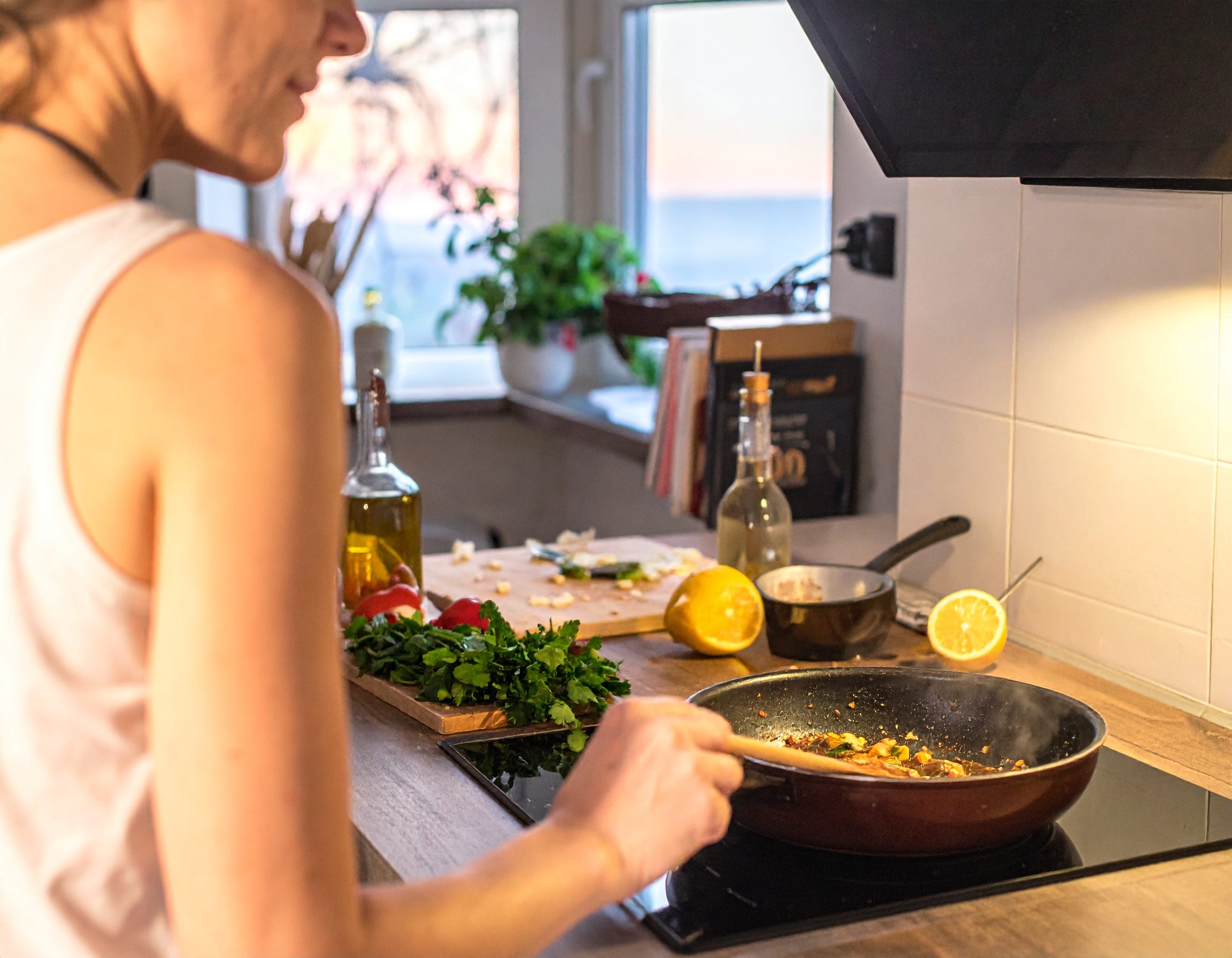
Weeknight cooking is cooking under real conditions. Limited time — thirty minutes on a good night, sometimes less. Limited energy — you have been working all day, you are tired, you are hungry, the last thing you want is a project. Limited ingredients — whatever is in the fridge plus whatever you were able to grab from the store, which may not have been much. No audience, no performance, no particular aspiration beyond getting something genuinely good on the table before you are too hungry to care.
These are the hardest conditions under which to cook well. And cooking well under them, consistently and without drama, is a genuine skill — one that takes time to develop, that improves meaningfully with practice, and that produces outcomes that matter far more than most people realize.
What the skill actually involves
Weeknight cooking is not one skill. It is a cluster of related skills that develop together over time and that, taken together, constitute a kind of practical intelligence about food that has significant effects on daily life.
There is the skill of knowing what you have and what you can make from it — the ability to open a fridge, assess its contents, and generate a reasonable dinner from what is there without a recipe or a plan. This is harder than it sounds and more learnable than most people think. It is essentially a pattern recognition skill — knowing which flavors work together, which techniques apply to which ingredients, which combinations reliably produce something good. It develops with repetition, not study.
There is the skill of time management in the kitchen — knowing how to sequence the steps of a meal so that everything is ready at roughly the same time, how to use the time while one thing is cooking to prepare the next thing, how to make thirty minutes feel like enough time rather than not enough. This is an organizational skill as much as a culinary one, and it is one that most beginner cooks lack and most experienced cooks have internalized to the point where it is no longer conscious.
There is the skill of seasoning — knowing how to make food taste fully of itself, how much salt is enough, when acid is needed, when heat or fat or sweetness is the missing element. This is the skill that most separates good home cooks from adequate ones, and it is almost entirely developed through practice and attention rather than through instruction.
There is the skill of flexibility — knowing when a recipe can be deviated from, when a substitution will work, when the dish needs something different from what is written. This is the skill that makes cooking practical rather than stressful, that allows real-life weeknight conditions to produce good food rather than anxiety and failure.
And there is the meta-skill that underlies all of these: the ability to remain calm and creative under conditions of scarcity and time pressure. The ability to look at what you have, accept the constraints, and make something good within them rather than being paralyzed by what is missing or what could have been different.
Why it matters more than most people think
The case for weeknight cooking as a genuinely important life skill rests on several arguments that go well beyond the obvious ones.
It is the primary determinant of how you eat.
Not your intentions, not your dietary philosophy, not the meal plan you made on Sunday and abandoned by Wednesday. What you actually eat on an ordinary weeknight is determined almost entirely by whether you can cook something good in the time and energy available — which is to say, by whether you have the skill of weeknight cooking.
People who have this skill eat differently from people who do not. Not because they have better intentions or stronger motivation or more commitment to healthy eating, but because the skill makes the healthy choice the easy choice on an ordinary Tuesday evening. The meal gets made not because they pushed through resistance but because making it required no more effort than any alternative. The skill is the infrastructure of good eating.
It compounds over time.
Every meal you cook is practice. Every practice session builds the skill incrementally — the seasoning gets slightly more intuitive, the time management gets slightly more automatic, the repertoire of reliable meals grows by one more entry. The improvement is invisible in any individual meal and dramatic over years.
The person who has been cooking weeknight meals for five years cooks differently from the person just starting out — not because they know more recipes or have fancier equipment, but because five years of practice has built a kind of kitchen intelligence that cannot be acquired any other way. And this intelligence makes the cooking easier, faster, more reliable, and more pleasurable than it was at the beginning.
This compounding means that the investment in the skill is front-loaded. The early cooking is the hardest — the most effortful, the most uncertain, the most likely to produce disappointing results. The later cooking is easier and better and requires less effort than it used to. The skill, once built, pays returns indefinitely.
It is the most reliable path to eating well over a lifetime.
Diets end. Plans get abandoned. Meal delivery services get cancelled when the budget tightens or the novelty fades. Weeknight cooking, once it becomes a habit and a skill, does not end. It continues because it has become the default — the thing you do because it is easier than the alternative, because you are good at it, because it has become as automatic as any other daily habit.
The person who can cook a genuinely good weeknight meal in thirty minutes does not need a meal plan or a diet or a delivery service. They need a reasonably stocked kitchen and the time to cook, which they already know how to use. Their eating is not dependent on continued motivation or external structure. It is self-sustaining, because the skill is self-sustaining.
It saves money in ways that compound over a lifetime.
The financial case for weeknight cooking is almost too obvious to make, and yet it is underappreciated in aggregate. The person who cooks five weeknight meals at home instead of ordering them spends, conservatively, a third to a half of what the ordered meals would cost. Across a year, this is thousands of dollars. Across a decade, it is tens of thousands. Across a lifetime, it is a genuinely significant sum — one that most people, if asked to name the financial decisions that had the greatest impact on their lives, would not think to include but that rivals many of the decisions they do think of.
It produces a quality of daily life that money cannot buy.
This is the argument that is hardest to quantify and easiest to underestimate. The experience of sitting down to a meal that you made, that is genuinely good, on an ordinary Tuesday evening — not because you had time or energy to spare, but because you have developed the skill to make something good when time and energy are limited — is a specific and recurring pleasure that improves the texture of daily life in ways that are difficult to articulate but easy to feel.
It is not a grand pleasure. It is a quiet one. But quiet pleasures that occur multiple times a week, every week, accumulate into something significant. The person who regularly sits down to a meal they made and enjoys it has a better daily life, in a specific and material way, than the person who does not — regardless of what else is equal between them.
Why it is underrated
Weeknight cooking is underrated for several reasons that are worth naming, because naming them makes it easier to see past them.
It is domestic, which in most cultures means it has been historically feminized, and things that are feminized tend to be systematically undervalued regardless of their actual importance. The person who cooks dinner every night for a family is doing something genuinely skilled and genuinely important, and the culture has tended to treat it as unremarkable — something anyone can do, something that does not require particular ability, something that certainly does not require the respect accorded to skills that are practiced in more visible domains.
It is ordinary, which means it does not announce itself. The weeknight meal does not look impressive. It does not invite admiration. It is just dinner, made on a Tuesday, eaten and cleared away. The ordinariness makes the skill that produced it invisible in a way that more spectacular cooking is not.
It is associated with constraint — with limited time and limited energy and limited ingredients — which makes it feel like the inferior version of cooking rather than its own demanding form. But constraint is not inferiority. Constraint is difficulty of a specific kind, and cooking well under constraint is harder, in many ways, than cooking well when everything is available and time is unlimited.
How to build the skill
The skill of weeknight cooking is built the same way all skills are built: through deliberate practice, sustained over time, with attention to what is working and what is not.
The starting point is not a course or a book or a set of techniques to learn. It is simply cooking — regularly, with the intention of getting better rather than just getting through. It is showing up in the kitchen on Tuesday even when you would rather not, making something from what you have, noticing what worked and what did not, and doing it again on Thursday.
The skill develops fastest when you cook the same things repeatedly rather than trying something new every night. A repertoire of eight to ten meals you know well enough to make without thinking is more valuable than fifty meals you have made once and mostly forgotten. Repetition builds the automaticity that makes weeknight cooking feel effortless rather than effortful.
It also develops through paying attention — to how the onions look before the next ingredient goes in, to when the dish needs more salt or more acid, to the signs that something is done or not done. This attention is the practice within the practice, and it is what separates cooking that improves over time from cooking that simply repeats.
What Joyvela is trying to do
Every recipe in the Joyvela archive is designed for this skill — for the real conditions of weeknight cooking rather than the ideal conditions of cooking as hobby or performance. Thirty minutes or less. Ingredients that are genuinely available. Techniques that can be executed when you are tired. Results that are worth making again.
We are not trying to give you impressive recipes. We are trying to give you reliable ones — meals that work under real conditions and that contribute, one Tuesday at a time, to the development of the skill that makes eating well not a project but a practice.
Because that is what weeknight cooking is. Not a hobby, not a chore, not a domestic obligation. A skill — one of the most underrated and most valuable you can have. And one that gets better every single time you use it.